HOW MUCH PHANTOM POWER?©2002 ~ 2013 by Eddie Ciletti
Appeared in MIX magazine August 2002
Updated 5 December 2013There is an overall fear of Phantom Power, which under normal circumstances is invisible to Dynamic Mics, both coil and ribbon. Phantom Power is for professional condenser mics equipped with an XLR connector and NOT for computer / gaming headset mics equipped with a 3.5mm TRS plug. (Headset mics are typically Electret and require only 1.5 volts.) Phantom power is backward compatible with all Dynamic Mics.
When possible, it is a good idea to have the master phantom power supply turned off until all mics are plugged in. This is difficult to achieve under normal conditions, and so it is perfectly fine to plug a ribbon mic's XLR cable into a mic panel (or preamp) with phantom power on. That said, Phantom Power must be off IF the mic lines appear in a patch bay.
Phantom Power is distributed as a common-mode DC signal riding piggy-back on top of the balanced audio signal. 48 volts DC is applied to both pin-2 and pin-3, ground is on pin-1. Plug in a mic cable and power is safely applied, but connecting a mic via TRS patchbay applies 48 volts to tip (pin-2) while the ring is momentarily connected to ground. While the full 48-volts is isolated from the coil or ribbon via transformer, patching (or a mis-wired / broken cable) can send a damaging spike across the coil or ribbon
Condenser mics require power for their internal electronics and to polarize the capsule. Vacuum tube mics require an external power supply. Early solid-state ('transistorized) condenser mics could be internally powered via battery or via Phantom Power without special cables and with no harm to existing dynamic microphones - they don't even see it! Watch this video about how a condenser mic is made.
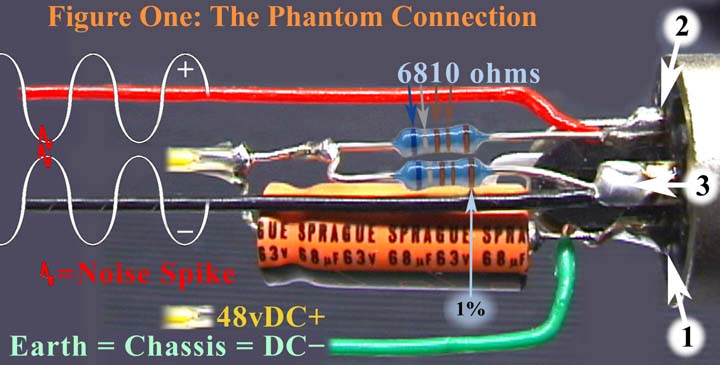
In Figure-1, the pair of sine waves represent the differential audio signals - one signal is 180-degrees out-of-phase (reverse polarity) with the other. Both Phantom Power and Noise (red spikes) are common mode - they have the same polirity on pin-2 and pin-3. When all the signals get to the pre-amp, its differential input amplifier does just that, it "looks for the difference," subtracting pin-2 from pin-3 translates into a double negative - otherwise known as "addition" for the intended audio, but "subtraction" for the noise (a.k.a. cancellation). The relationship between signal amplification and noise rejection is called the Common Mode Rejection Ratio (CMRR). Table-1 shows how CMRR can be different at various frequencies.
Figure-1 shows the essential hardware: 48-volts feeds a pair of 6k8-ohm resistors connected to pin-2 and pin-3, the signal pins. The DC "return" path shares pin-1 with the earth / shield connection. A local capacitor keeps the signal clean.
|
|
|
|
|
|
|
|
|
|
|
|
TABLE-1: Common Mode Rejection Ratio (CMRR) specs for three frequencies as published by John Hardy for his Twin Servo 990 mic preamp using the Jensen JT-16-B Input Transformer.
Click on these links, if you want to know how much current is available to - and what typical condenser mic current draw is. For more on Ribbon Mics, check out "Tiny Ribbon, Big Sound" sidebar.
AVOID A DREADFUL MIS-CARRIAGEUnder normal circumstances 48-volts is applied to both pin-2 and pin-3 (with respect to ground) and not across the coil or ribbon, both of which are typically isolated from the outside world via transformer. Since there is no potential difference, Phantom Power is invisible to dynamic and ribbon mics. However, if pin-1 and pin-2 (or pin-1 and pin-3) are reversed — as would happen with a mis-wired cable — either 48-volts would be applied across the mic’s transformer or across the capsule itself. Turning a dynamic mic into a tweeter is not a good thing. I’ve seen a bad cable trash a perfectly good Sennheiser MD-409 (that is not transformer isolated).
The output impedance of most microphones is 200-ohms — 50-ohms for ribbon mics; the ribbon itself is less than an ohm and requires a step-up transformer to get the signal to a useable level. An input transformer’s DC Resistance (10-ohms to 40-ohms, typical) is considerably lower than its AC Impedance (300-ohms to 1k2-ohms, typical). Connecting a mis-wired cable with the phantom power ON will send a momentary spike across the transformer to the coil or ribbon, stretching the latter out of shape.
CONDENSATIONCondenser mics are thirsty for power; tube mics in particular require their own supplies most of which are bulky, inconvenient but beautiful. Solid-State Condenser mics were liberated by Phantom Power, allowing some to be battery operated.
As you can see in Table-2, some mics will operate on as little as 9 volts on up to 52volts, thanks to a "switching" or switch-mode power supply that converts phantom power into the necessary capsule polarizing voltages. Pretty clever, eh? Two condenser mics publish their current requirements as 3mA. As you can see, not all the mics shown have the same voltage tolerance or current demands.
|
|
|
|
|
|
|
|
25mm diaphragm condenser |
as per DIN 45596 |
|
|
|
|
as per DIN/IEC |
|
|
|
26mm diaphragm condenser |
3 mA typical |
|
|
|
condenser |
|
|
|
|
condenser |
3mA |
Table-2: Phantom power requirements of a few select condenser mics.
HOW MUCH?Just a quick detour to our old buddy Ohm’s Law, with a little test to see how much current might be supplied by the phantom power distribution circuit (and mis-applied to a mic’s output transformer under mis-wired conditions).
Using Figure-1 as reference, short pin-2 and pin-3 to ground so that the two 6k8-ohm resistors combine in parallel to become 3k4 ohms. Apply Ohm’s Law: A=V/R (Amps equal Voltage divided by Resistance); the maximum current that can be delivered by two resistors to ground is 14milliAmps (mA) = 48-volts / 3400-ohms or 7mA per resistor. The resistors plus the low DC Resistance of a transformer (5-ohms to 50-ohms) makes almost no difference in the total current, which is considerably high for this application, enough to power an LED! Remember that DC does not travel across the transformer windings, it just appears as a momentary spike.
So, when building a phantom power supply to power multiple microphones, simply use 14mA per microphone as the reference. No one microphone requires this much power, but it will ensure that the power supply is operating with a comfortable margin — headroom — when driving ALL microphones. A supply designed for 24 condenser microphones should be capable of delivering 360mA without a sweat — that's less than 1/2 amp!
TINY RIBBON, BIG SOUNDI spoke with both David Royer — www.royerlabs.com — and Wes Dooley of Audio Engineering Associates — www.wesdooley.com — both of whom manufacture ribbon microphones in the good old US of A. Each does their best to educate users on the do’s and don’ts of ribbon technology, offering mic placement tips, accessories and a generous warranty policy. (Ribbons are more vulnerable to plosives than dynamic mics.)
Wes manufactures the AEA R44 to the original specs offering replacement parts that are interchangeable with the original RCA 44 ribbon mic. Like many retro manufacturers, Wes has taken the time to talk to veteran designers and engineers, collecting some of their stories and sharing them at every opportunity.
The "ribbon" is a narrow strip of aluminum foil — originally hammered out in the same old-world style tradition as gold leaf — gently locked into place with just enough tension to center it within an extremely powerful magnetic gap. (The resonance is at the lowest possible extreme of the audio band.) It is both delicate and articulate. Ribbon microphones are perfectly capable of interfacing with phantom power so long as the cables are correctly wired. IF you have a transformer-less mic preamp, turn the phantom power off before connecting the mic, allowing time for the blocking caps to discharge just in case they do so at an uneven rate.